
🏗️ $40B East Africa Trade Bet
To the network,
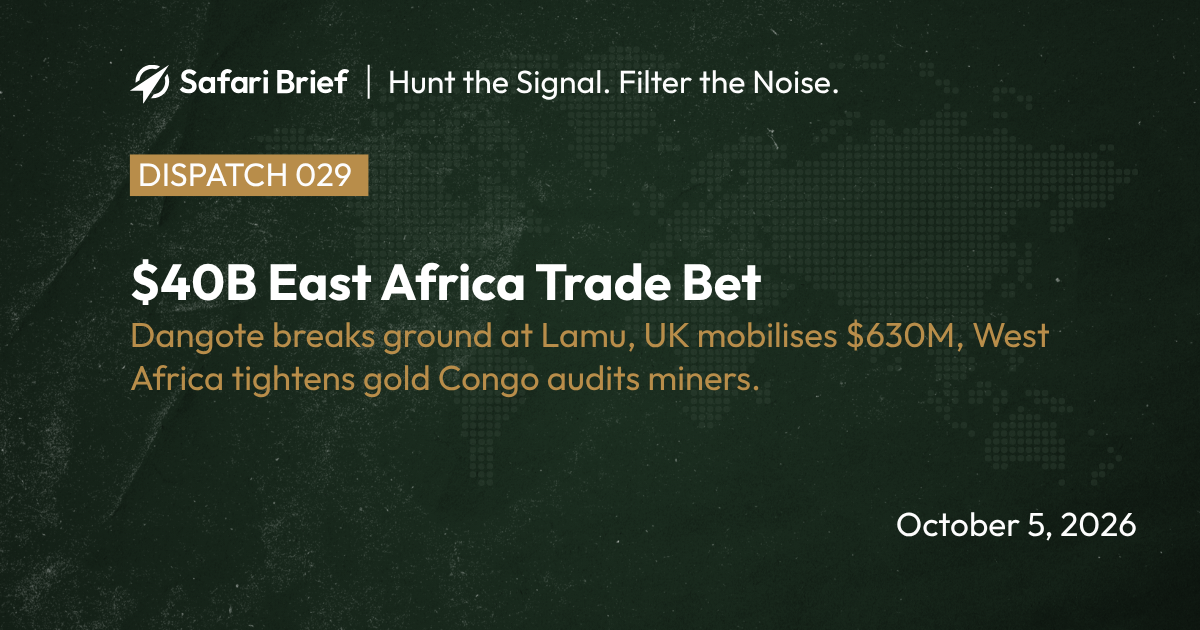
East Africa is no longer waiting for downstream capacity to arrive from abroad. Dangote has broken ground on a $16 billion refinery at Lamu, Honeywell has signed a $300 million contract, and the first 2,930-tonne machinery cargo is already at Mombasa anchoring a $40 billion Indian Ocean trade corridor alongside Turkish and Gulf-backed projects. Meanwhile, Burkina Faso opened a $19 million gold refinery, Ghana advances state share rights in mining firms, and Congo will audit major miners annually from 2027. Kenya is in advanced talks with Washington on critical minerals, and Airtel Money is preparing an $800 million London IPO at a $7 billion valuation. African capital is building its own architecture and setting its own terms.
Let's hunt.
🏗️ Dangote Commences $16B Lamu Refinery Construction
- Dangote has formally broken ground on the $16 billion Lamu refinery, awarding a $300 million technical contract to Honeywell as the first 2,930-tonne heavy machinery shipment docks at Mombasa.
- The Lamu complex serves as the anchor for $40 billion in East African Indian Ocean trade infrastructure. This establishes a high-capacity Kenya-Rwanda fuel corridor, forcing regional logistics operators to reposition around Lamu as the definitive downstream processing node.
🌊 $40B Capital Consolidation Targets East African Corridors
- Dangote, Turkish industrialists, and Gulf-backed consortiums are deploying an aggregate $40 billion across three mega-projects, structuring the Lamu refinery, integrated pipeline networks, and port expansions into a unified continental gateway.
- East Africa is cementing its Indian Ocean dominance. For freight operators, this fundamentally alters maritime economics, redirecting cargo from congested Red Sea transshipment routes into highly capitalized, multimodal corridors linking landlocked markets directly to deepwater terminals.
💎 Botswana Leverages Diamond Assets for Sovereign Equity
- Gaborone has escalated negotiations to secure a larger ownership stake in De Beers, prompting Moody’s to analyze the sovereign credit implications as the state attempts to extract superior margin capture from its Anglo-American partnership.
- The sovereign posture is shifting from passive royalty collection to aggressive equity extraction. The outcome of these negotiations will establish a hard precedent for sovereign-operator partnerships across all Southern African extractive jurisdictions.
🥇 West Africa Institutionalizes Downstream Gold Capture
- Burkina Faso has commissioned a $19 million sovereign gold refinery, while Ghana’s parliament advances legislation mandating specialized state equity rights within international mining firms, consolidating control over the regional gold value chain.
- This is a synchronized acceleration of sovereign value capture. Capital allocators must structurally integrate mandatory domestic refining quotas and state carried-interest provisions into financial models before any West African asset reaches bankability.
🏦 Egypt’s MNT-Halan Structures 20% Domestic IPO
- Egyptian fintech unicorn MNT-Halan is preparing a 20% equity float on the Egyptian Exchange (EGX), executing North Africa's most consequential fintech listing to date and testing the liquidity depth of regional capital markets.
- The listing will benchmark whether African digital champions can sustain premium valuations outside Western exchanges. Regional bourses are actively positioning themselves as highly viable exit mechanisms for maturing, high-growth technology assets.
⛏️ DRC Mandates Annual Audits for Tier-1 Mining Operations
- Kinshasa’s mining regulator has mandated comprehensive annual audits for all major operators starting in 2027, concurrent with Copper Intelligence and CoTec advancing localized tailings-processing capabilities.
- The DRC is institutionalizing oversight to maximize revenue from existing concessions. While this elevates baseline compliance costs for operators, it simultaneously unlocks high-yield opportunities in brownfield recovery and legacy tailings retreatment across the Copperbelt.
🔋 South Africa Secures $3.7B EV Battery Supply Node
- South Africa has secured a critical battery-materials processing facility within a $3.7 billion European EV supply chain, positioning the sovereign as a strategic manufacturing node rather than a mere resource provider.
- This represents the continent's most significant leap into the advanced EV value chain. For operators, it confirms that European automotive manufacturers are aggressively de-risking supply by moving specialized processing infrastructure closer to the primary extraction point.
📱 Airtel Money Targets $8B Valuation in London IPO
- Airtel Money is structuring an $800 million listing on the London Stock Exchange at a target valuation of $8 billion, offering investors a direct, high-liquidity entry point into the continent’s accelerating mobile payment network.
- London retains its position as the dominant listing venue for African fintech scale-ups. However, the $8 billion valuation threshold will severely test whether mobile-money multiples can be sustained amid intensifying competition from telco-agnostic and banking platforms.
🔶 Kenya and US Advance Bilateral Critical Minerals Framework
- Nairobi is finalizing a critical minerals partnership with Washington, as the US accelerates capital deployment to secure independent energy-transition supply chains outside established Asian processing monopolies.
- Kenya is securing its position as Washington’s preferred East African critical minerals anchor. While this unlocks substantial US development finance for localized processing infrastructure, operators must critically evaluate the framework for sovereign value-retention safeguards.
🇺🇸 Diplomatic Friction Strains $28.8B US-South Africa Trade Axis
- Pretoria summoned the US ambassador over alleged domestic interference, maintaining high-level dialogue to prevent US visa restrictions from destabilizing a $28.8 billion bilateral trade relationship.
- Diplomatic volatility has hardened into a quantifiable commercial risk. Corporates maintaining dual exposure to US and South African markets must prioritize currency hedging and supply-chain diversification as geopolitical friction accelerates.
💧 SA and Zimbabwe Structure $500M Cross-Border Dam Project
- Pretoria and Harare are negotiating a $500 million cross-border water infrastructure project, deepening bilateral resource cooperation to address chronic deficits limiting agricultural and industrial output.
- Cross-border water management is emerging as a critical stabilizing mechanism. For agricultural and industrial operators, this infrastructure unlocks essential irrigation capacity in a region where climate stress has become a permanent, unhedgable balance-sheet liability.
⚖️ Tullow Oil Loses $393M Ghanaian Sovereign Tax Arbitration
- Tullow Oil has been defeated in a $393 million tax arbitration ruling against Ghana, highlighting the aggressive sovereign posture regarding hydrocarbon revenue capture across West Africa's emerging basins.
- Accra's victory establishes a potent precedent for retroactive revenue claims. Upstream operators and project financiers must immediately revise tax risk premiums upward across all West African frontier and established basins.
🇬🇧 UK Development Finance Mobilizes $630M in Nigeria
- A UK-backed investment program has successfully mobilized $630 million in private capital and generated 21,400 jobs within Nigeria, proving the efficacy of targeted blended finance without expanding sovereign debt burdens.
- This provides a replicable blueprint for scaling private-sector growth without exacerbating debt distress. Nigerian operators retain access to highly concessional capital pools specifically targeting agribusiness, advanced manufacturing, and SME scaling.
🏛️ Abu Dhabi’s $300B Wealth Empire Accelerates African Deployment
- The UAE's Crown Prince is directing a $300 billion sovereign wealth empire toward establishing new African trade corridors, expanding Gulf capital allocation beyond legacy energy assets into ports, critical minerals, and agricultural logistics.
- Gulf sovereign wealth has definitively become Africa's most aggressive external capital source. Operators gain access to patient, long-horizon liquidity, but must navigate intensifying competition as Abu Dhabi structurally locks down strategic infrastructure.
✈️ Ethiopian Airlines Scales Cargo Capacity with 10 Boeing Freighters
- Africa’s dominant carrier has executed an order for 10 Boeing freighters (with options for 8 additional aircraft), significantly expanding its dedicated cargo fleet to capture accelerating AfCFTA-driven trade volumes.
- Ethiopian Airlines is systematically constructing the logistical spine for the continent's single market. The allocation of air freight capacity will increasingly dictate which operators successfully capture high-margin, time-sensitive continental trade flows.
🔍 ON OUR RADAR — Quick Hits
🔌 Sub-Saharan Grid Failure: Recent data confirms that half of Sub-Saharan Africa relies on generator power, establishing grid unreliability as a structural, long-term constraint on manufacturing competitiveness.
🚂 AfDB and Germany Launch Rail Initiative: A new bilateral partnership focuses on financing regional rail integration and cross-border freight corridors, operationalizing AfCFTA logistics.
🛢️ Tullow Advances Ghanaian Drilling: Despite the $393 million tax arbitration defeat, Tullow has awarded a rig contract to Noble, indicating that the underlying asset quality sustains West African upstream investment.
How did this week's intelligence ledger grade against your operational mandate? Reply with 🔥 (Signal), 🥱 (Noise), or 🗑️ (Fluff). Spot a continental tectonic shift we missed? Send it up the chain.
We will be back next Monday assuming another sovereign doesn't rewrite its mining code before breakfast.
The Safari Brief Intelligence Unit
Hunt the Signal. Filter the Noise.