
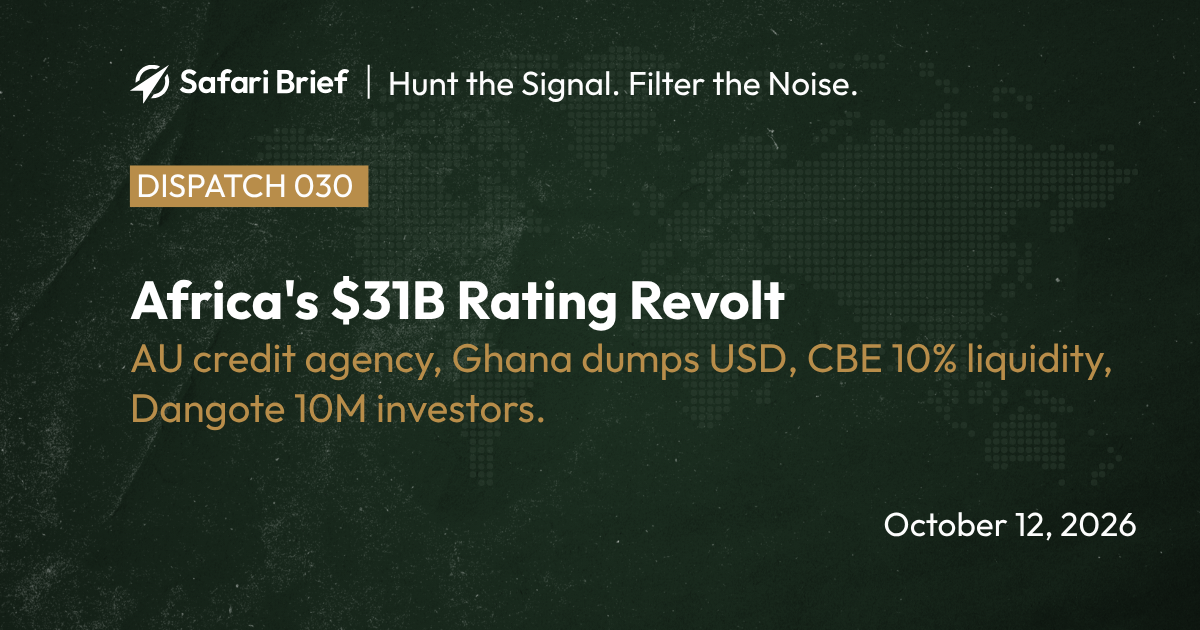
🏦 Africa's $31B Rating Revolt
AU launches homegrown credit agency, Ghana bypasses USD, CBE proposes 10% liquidity Dangote IPO targets 10M.
To the network,
The African Union has launched a homegrown credit rating agency to directly challenge Moody's, S&P and Fitch targeting the $31 billion risk premium that inflates the continent's borrowing costs. Egypt's central bank governor has proposed deploying 10% of Africa's banking liquidity within the continent. Ghana is now clearing gold trade with China in yuan as Beijing unlocks zero-tariff access for 53 African nations. And Dangote's refinery IPO is targeting 10 million investors across the continent. The architecture of African capital is being rebuilt from ratings to settlement to retail distribution. The winners are sovereigns who set their own terms and operators who position before the repricing.
Let's hunt.
⚖️ AU Launches Sovereign Credit Rating Agency
- The African Union has launched the continent's first homegrown credit rating agency (AfCRA) to directly challenge the global oligopoly, targeting the $31 billion risk premium that inflates regional borrowing costs.
- This is a direct assault on the hidden tax applied to African capital. A credible, independent continental rating agency could structurally lower sovereign borrowing costs and unlock institutional financing currently priced out of reach by Western methodologies.
💵 CBE Proposes 10% Continental Banking Liquidity Retention
- Egypt's central bank governor has formally proposed deploying 10% of Africa's aggregate banking liquidity exclusively within the continent, aiming to redirect offshore capital back into regional infrastructure.
- If adopted, this is the largest capital mobilisation proposal in African financial history. Hundreds of billions currently parked offshore could be redeployed into continental infrastructure, energy and industry ending four decades of structural dependence on foreign capital.
💰 Dangote IPO Targets 10M Pan-African Retail Investors
- Dangote Refinery has set an ambitious 10-million-investor target for its IPO, securing regulatory approvals in Uganda and Kenya to execute the continent's largest retail capital mobilization.
- This is retail capital extraction at an unprecedented scale. If the "people's IPO" succeeds, it establishes a replicable framework for pan-African equity distribution, proving mega-projects can be capitalized domestically without reliance on Western intermediaries.
🌍 Ghana Clears Gold Trade in Yuan, Bypassing the US Dollar
- Ghana is executing direct gold trade settlement with China in yuan, bypassing the US dollar just as Beijing activates zero-tariff access for 53 African nations.
- This is de-dollarisation in practice, not rhetoric. Direct yuan settlement cuts FX conversion costs and sidesteps US sanctions exposure but concentrates trade dependency on a single counterparty whose strategic agenda is not Africa's. The savings are real; the leverage is not yet.
📱 West Africa’s $267B Mobile Money Sector Faces Pricing Shock
- West Africa's $267 billion mobile money market is experiencing a severe pricing correction, with operators capping fees and zero-rating transfers to capture market share.
- Margin compression is the point, not the side effect. Capped fees will force consolidation across the region, favouring platforms with lending, insurance and merchant-services revenue and killing pure-play transfer businesses within eighteen months.
⚡ Trafigura Capitalizes $300M Zambia-DRC Power Corridor
- Global trading house Trafigura and its partners have backed a $300 million cross-border power interconnector linking Zambia and the DRC to support the rapidly expanding Copperbelt mining complex.
- Baseload power remains the binding constraint on Central African critical minerals. This infrastructure investment unlocks immediate production capacity but ties regional mining output to a single energy corridor a concentration risk operators must immediately price into off-take agreements.
🇿🇼 Zimbabwe Mineral Earnings Double Following Export Bans
- Zimbabwe’s mineral export revenues doubled to $4.7 billion, driven heavily by refined lithium following Harare’s aggressive ban on raw spodumene exports.
- This proves hard resource nationalism yields immediate balance-sheet results. Harare restricted raw extraction, forced localized processing, and doubled sovereign earnings providing a highly visible playbook that every resource-endowed African sovereign will study before its next policy mandate.
🔶 Ivanhoe's Kamoa-Kakula Copper Output Surges 19%
- Ivanhoe Mines reported a 19% surge in copper production from the DRC's Kamoa-Kakula complex following the resolution of earlier grid disruptions, reinforcing the basin's role in the global energy transition.
- Every tone of Congolese copper moves global pricing. Kamoa-Kakula's rebound stabilizes Central African supply, but it also exposes how much of the world's energy transition rests on a single asset's operating performance in one province.
💵 Zambia Secures $1.5B in US Health Financing
- Lusaka secured a $1.5 billion US health support package after resolving bilateral data-sharing disputes, delivering critical sovereign fiscal relief and re-anchoring US-Zambia diplomatic relations.
- Health financing is the diplomatic lubricant for the minerals deal now under negotiation. Washington is buying influence in Lusaka ahead of the critical minerals carve-up and Zambia is collecting the down payment before it signs anything.
⚡ Yinson Executes $1.46B Agogo FPSO Refinancing
- Yinson Production has successfully launched a $1.46 billion bond sale to refinance the Agogo FPSO offshore Angola, capitalizing on surging global demand for deepwater floating production capacity.
- FPSO refinancing at this scale proves institutional appetite for African offshore energy has not cooled. The Agogo terms will now become the reference price for every West African deepwater project lining up behind it.
🔋 South Africa Pivots to 4,600MW of Grid-Scale Battery Storage
- Transitioning away from baseload generation constraints, South Africa is targeting the deployment of 4,600MW of battery energy storage systems (BESS) to absorb and dispatch surplus renewable electricity.
- This is a major bet on grid-scale storage and a confession that generation alone did not solve the crisis. The transition is moving from building power plants to managing power flows, and the capital follows the constraint.
🛢️ Nigeria’s $1.3B Hydropower Asset Runs at Half Capacity
- Nigeria’s $1.3 billion Zungeru hydropower plant is operating at 50% capacity, triggering regulatory reviews as industrial manufacturers continue to face acute base-load deficits.
- This reinforces the captive power arbitrage. When a $1.3 billion state asset runs at half capacity, self-generation stops being a cost center and becomes a competitive moat. The industrial map redraws around who can keep the lights on.
📡 Starlink Secures Fleet-Wide Deal with Royal Air Maroc
- Elon Musk’s Starlink has executed an agreement to connect 41 aircraft for Royal Air Maroc, establishing the North African operator as the first continental carrier to deploy satellite-based inflight Wi-Fi at fleet scale.
- This sets a new passenger experience benchmark across African aviation. Satellite connectivity is now fleet-standard, not a differentiator and carriers that delay the upgrade will lose premium cabin revenue to airlines that have already made the call.
🔶 Zimbabwe Unlocks $100M for Sanctioned Sovereign Gold Asset
- Harare has successfully secured $100 million in initial offshore financing for a $500 million mining project holding 44 million ounces of gold, bypassing Western sanctions pressure to advance sovereign extraction.
- This proves large-scale mining capital can still reach Zimbabwe when structured correctly. The offshore SPV template staged drawdowns, sovereign support, ring-fenced collateral is becoming the standard playbook for deployment into sanctioned jurisdictions.
💵 Ethiopia Deploys $840M in Forex Auctions to Defend Currency
- The National Bank of Ethiopia (NBE) has allocated $840 million for Q2 forex auctions, aggressively deploying sovereign reserves to stabilize the birr and inject liquidity into the import-dependent economy.
- Ethiopia is spending reserves to defend its currency. Short-term import liquidity eases, but sustainability depends entirely on export growth and structural reform. The birr's trajectory is the referendum on whether this works.
🔍 ON OUR RADAR - Quick Hits
🏎️ Rwanda Nears Africa's First F1 Grand Prix. Rwanda closes in on hosting Africa's first Formula 1 race in 33 years, ahead of South Africa and Nigeria, backed by a $410M circuit project.
🍫 Ghana Cocoa Regulator Raises $288M. Emergency financing to keep farmers selling amid a cash crunch in the world's second-largest cocoa producer.
💎 Namibia Diamond Mine Revival Draws $50M. Renewed investment signals confidence in Namibia's diamond sector despite global market pressures.
🗺️ Congo Launches Geological Survey. Kinshasa begins a national survey to unlock mineral potential and attract exploration capital beyond copper and cobalt.
🥇 SigraFi Raises $35M for Artisanal Gold. New platform connects artisanal gold to institutional markets, formalizing a multi-billion-dollar informal sector.
How did this week's intelligence ledger grade against your operational mandate? Reply with 🔥 (Signal), 🥱 (Noise), or 🗑️ (Fluff). Spot a continental tectonic shift we missed? Send it up the chain.
We will be back next Monday assuming another sovereign doesn't rewrite its mining code before breakfast.
The Safari Brief Intelligence Unit
Hunt the Signal. Filter the Noise.